The Sun Danced, and Nobody Owned It
Fátima is offered as Bayesian confirmation of Catholicism. The real work is done by a background no one is asked to defend.
The live Catholic case for Fátima is not, at bottom, a case about a dancing sun. It is a case about Bayesian confirmation.
In the modest academic form — Tyler Dalton McNabb and Joseph Blado’s 2020 Perichoresis paper — the Miracle of Fátima is evidence e that raises the probability of a Catholic Hypothesis relative to a background k. They are careful Swinburneans about this: they claim only a C-inductive lift, not that Catholicism is overall more probable than not. In the high-voltage popular form — Capturing Christianity, Capturing Catholicism, Ethan Muse’s documentaries, the conversion narrative that immediately framed Joe Schmid’s move into the Church — the same structure runs hotter. A predicted public sign, tens of thousands under a Portuguese sky, children who did not fold under threat: therefore the dogmatic package gets an extra confirmatory bump. The sun is not the prize. The prize is permission to treat the underlying Catholic theological worldview as newly better supported.
That is the move I want to put under a microscope. Not because strange things cannot happen in public, and not because witnesses are liars or fools. Because the confirmatory work is being done almost entirely by assumptions that never appear in the likelihood ratio as claims that need philosophical defense.
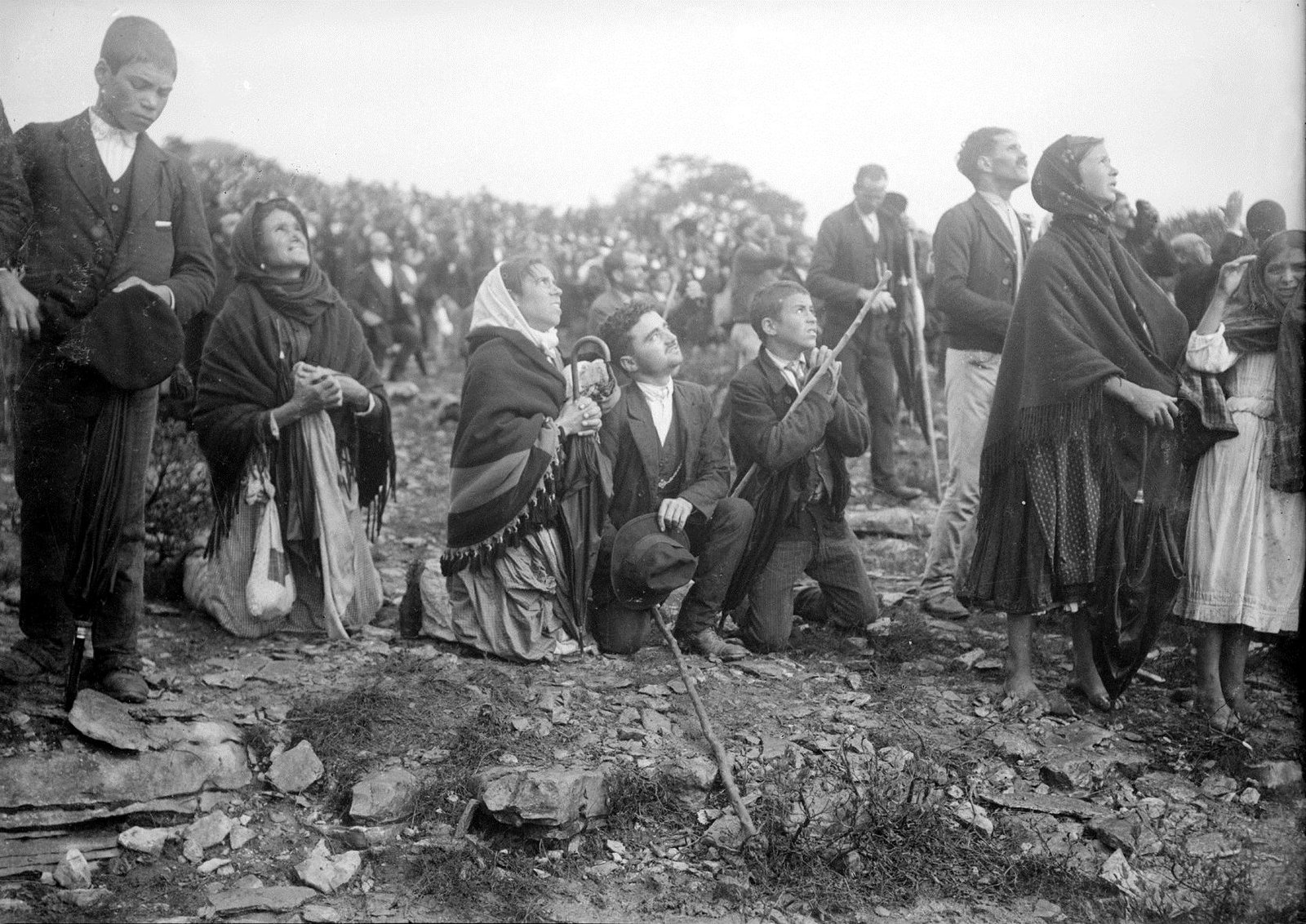
Look at what k is doing. For McNabb and Blado, background knowledge already includes Nicene Christianity and a thick Marian typology — Mary as Queen of Heaven, New Ark, New Eve — drawn from a particular reading of Scripture. The hypothesis under test is not “something mind-involving and weird occurred at Fátima.” The hypothesis is the core creedal Catholic package, and Fátima’s distinctively Catholic message content (Immaculate Heart, Rosary, the ecclesial Mary) is then treated as the sort of thing that preferentially confirms that package over rival Christianities. Meteorology may be allowed a cameo if God timed it; retina theories are rejected; mass hallucination is barely allowed into the room. What never gets a serious prior is the thought that a Marian-saturated culture, primed for months by prophecy and expectation, might co-create a public event in the symbolic language it already speaks — that the specificity which looks like a divine signature from outside might be, instead, the fingerprint of the belief climate that summoned the day.
Those are not small assumptions. They smuggle a whole philosophical anthropology: that consciousness is late enough, and matter finished enough, that a solar miracle must be either fraud, misperception, rare weather, or unilateral divine intervention; that apparitions are best read as independent messengers rather than as productions of collective psyche; that private revelation can function as public confirmation of institutional dogma; that the moral and metaphysical invoice attached to the institution — hell, penance, a sexual ethics Philip Goff refuses, an omnipotent love he treats as massively disconfirmed — is allowed to ride in on the signature once e has done its confirmatory work. None of that stack is examined as philosophy of mind, philosophy of perception, or metaphysics of value. It is treated as furniture. The Bayesian theater then begins, and Fátima is applauded for raising P(CH|k) while k sits in the dark wearing the manager’s badge.
Philip Goff’s brief reply to Joe’s conversion is useful here precisely because he notices the package. His comparative claim — telepathic mass hallucination is more plausible than Catholicism — is not an affirmative psychic theory. It is a refusal to let miracle-evidence override deep moral intuitions or clear the entire dogmatic city. On that refusal I am with him. Where he stops short, and where a Sethian frame begins, is in leaving the positive alternative as still essentially error: a shared solar mistake induced by children’s telepathy. Hallucination-language keeps mind in the story and still treats the crowd as wrong about the world.
Jane Roberts’s Seth offers a different positive ontology. In The Individual and the Nature of Mass Events, epidemics, wars, and so-called natural disasters are expressions of shared beliefs and intents — public events that meet collective psychological conditions, not merely accidents that happen to a population. In The Nature of Personal Reality, dictated in 1972 and 1973 and published in 1974, the same claim acquires a weather vocabulary almost embarrassingly apt for October 1917, in which storms and tornadoes belong to the same family of phenomena as wars and a thunderstorm is the outward, local materialization of the inner state of the people standing under it. In Session 666, in the book’s eighteenth chapter, Seth is speaking not about Fátima but about a flood, and he says of it: “The flood represented a mass psychic symptom projected upon the earth.” The extension to the Cova da Iria is mine, not his; but if a flood can be read as a mass psychic symptom projected upon the earth, then a solar anomaly over a field of tens of thousands of expectant pilgrims can be read in the same grammar, as a mass psychic event projected upon the sky. On that reading, Fátima is neither a referee’s whistle from outside the world nor a mass mistake about the world. It is weather: the weather of a belief climate dense enough to exteriorize as solar miracle. The sun danced because minds, together, can make a local stretch of reality denser than our textbooks. That denseness devastates textbook materialism. It does not, without a great deal more argument, Bayesian-confirm an unexamined Catholic dogmatic k.
The rest of this essay stays on that hinge. I will steelman the C-inductive case, name the philosophical assumptions packed into k, show how the likelihood ratio is rigged when mass-psyche rivals are never allowed into ~h, develop the mass-event and weather framing as the missing alternative, and refuse both trophy apologetics and cheap debunkery. “Responsibility without blame” — my phrase, not Seth’s — is the ethical posture underneath: take the event seriously as participation, not as a cosmic scorekeeper’s verdict that ends underdetermination by force.
How the confirmation argument is supposed to work
It is worth slowing down to state the argument at its strongest, because the strongest version is not the one that circulates in the comment sections, and the difference between the two is most of what this essay is about. McNabb and Blado borrow their machinery from Richard Swinburne, for whom a C-inductive argument for a hypothesis h succeeds just in case the evidence is more to be expected if h is true than if it is false, given what we already take ourselves to know: P(e|h&k) > P(e|~h&k). The criterion is deliberately weak. It does not say that h is now more probable than not, which would be a P-inductive claim, and the authors are explicit, more than once, that they are not making that stronger claim; they say only that the Fátima events nudge the needle, that whatever probability you assigned to Catholicism before October 1917, you should assign a little more after it. Anyone who has watched philosophers of religion overreach will recognize this as a genuinely disciplined posture, the posture of people who know that a single historical event, however strange, cannot carry a whole metaphysics on its back, and who therefore ask it to carry only a little.
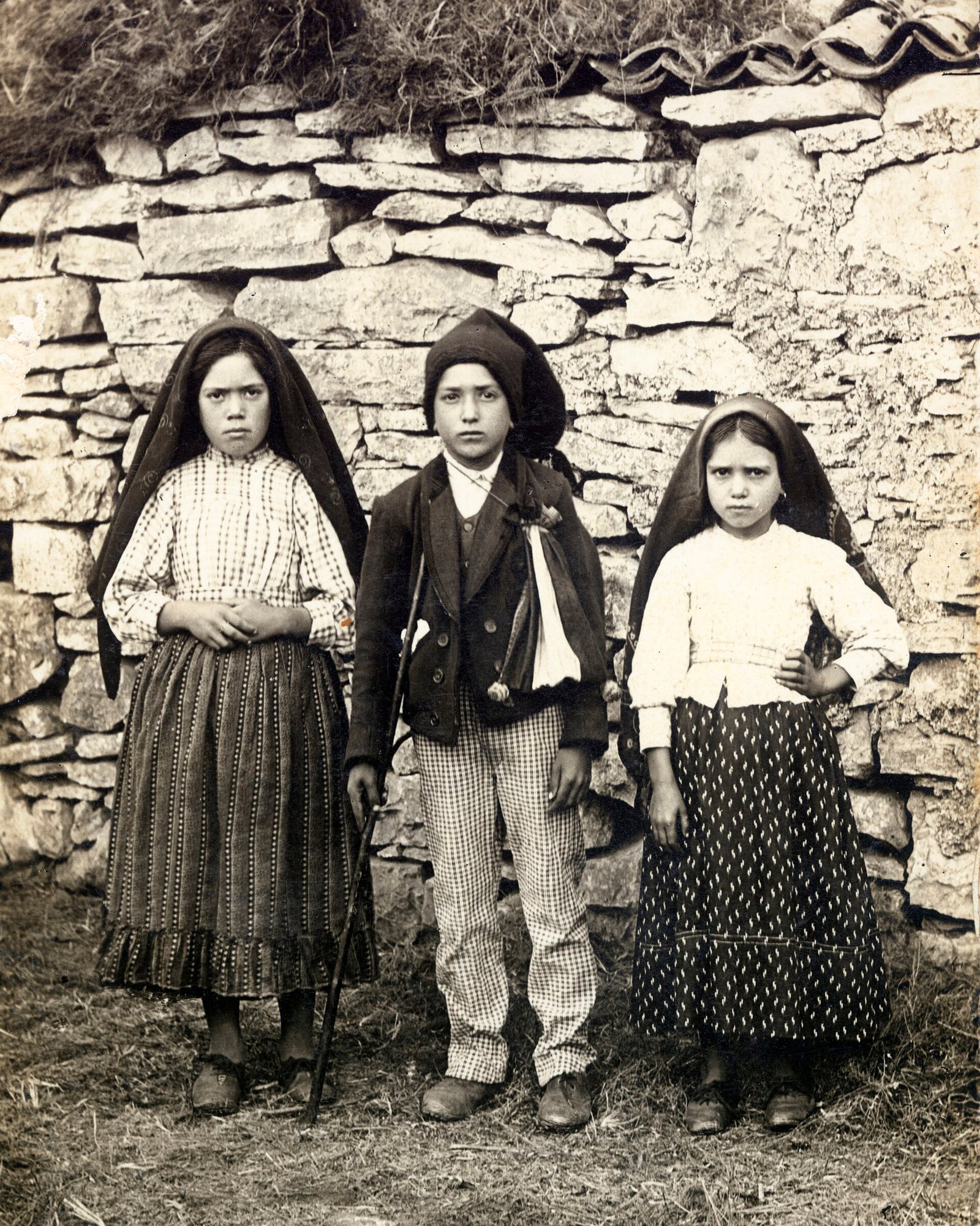
The ingredients are assembled with similar care. The hypothesis h is not a vague theism but the core creedal beliefs of the Catholic tradition, the Catholic Hypothesis, CH. The evidence e is not only the solar event of 13 October but the whole sequence that preceded it: the angel appearances of 1916, the six Marian apparitions from May to October 1917, the July vision of hell, the August detention of the three children by Artur de Oliveira Santos, the anticlerical administrator of Ourém, who by Lúcia’s own testimony threatened to have them boiled in oil and still failed to extract the secret or a retraction, and above all the announcement, made months in advance, that on the thirteenth of October at the Cova da Iria there would be a sign so that all would believe. The background k is where the authors do their most consequential work, though they present it as stage-setting rather than as a thesis: it includes the truth of Nicene Christianity together with a typological reading of Scripture, drawn from Brant Pitre and Scott Hahn, on which Mary is Queen of Heaven, New Ark of the Covenant, and New Eve. Given that background, the question is no longer whether God exists or whether the Incarnation happened; the question is which Christianity a Nicene God, who already has a Marian Queen in the wings, is more likely to vindicate by public sign.
Then comes the weighing of explanations, and here again the paper deserves credit for not simply waving at testimony. The solar-retina theory, on which prolonged staring at a sun partly veiled by cloud produces afterimages, apparent rotation, and colour shifts, is rejected on four grounds: it does not explain the reported drying of rain-soaked clothes and ground; it does not explain witnesses who were not staring and still reported the phenomenon; it does not explain why a large majority of a crowd would see roughly the same thing when ordinary sun-gazing does not reliably produce a shared spectacle; and it leaves the children’s sincerity to be explained by a separate hallucination theory bolted on afterward. The meteorological theory, which Stanley Jaki developed at length in God and the Sun at Fátima as a local temperature inversion and ice-crystal lens, fares better because it can handle drying, non-starers, and shared perception, but it cannot by itself explain why three peasant children knew, months in advance, the day, the hour, and the field. So McNabb and Blado, following Jaki, endorse a composite: a real atmospheric event, and God behind its timing and behind the apparitions that announced it. They concede, honestly, that some witnesses saw nothing or disputed what they saw, and they call this a weakness. They also offer a minimalist fallback, on which the miracle simply is the children’s ability to predict that something unusual would happen at that exact place and time. Finally, they argue that the content of the messages — consecration to the Immaculate Heart, the Rosary with its implicit commitment to the Assumption — is distinctively Roman Catholic, and that a figure representing a tradition who appears without denouncing it lends that tradition credence, as an apparition of Luther or Calvin endorsing justification by faith would lend credence to the Reformers.
Whatever one thinks of the conclusion, this is a respectable piece of analytic apologetics. It names its probabilistic standard, limits its claim, engages two naturalistic rivals with some specificity, admits a weakness, and refuses to pretend that a C-inductive lift is a proof. If the whole public conversation about Fátima sounded like this, the present essay would be a narrower technical reply about the composition of ~h.
It does not sound like this. In the popular apologetic ecosystem that has grown up around Capturing Christianity and its Catholic offshoot, around Ethan Muse’s Fátima documentaries and Cameron Bertuzzi’s interviews and the clip economy that redistributes them, the same structure is run at a different temperature. The predicted public sign, the tens of thousands of witnesses including anticlerical journalists, the children who would not recant under threat of being boiled in oil: these are presented not as a modest increment on a contested prior but as something closer to a verdict, the sort of thing a reasonable person, having seen it laid out, can no longer walk away from without intellectual dishonesty. The vocabulary shifts from “raises the probability of” to “best explained by,” and from “best explained by” to “God showed up,” and the C-inductive caution that McNabb and Blado wrote into their first page does not survive the trip to the thumbnail. I do not say this to sneer at popularizers, who have a different job; the gap matters philosophically. A modest lift on a background you already accept is one thing. A trophy that is supposed to settle which religious and moral world a person ought to inhabit is another, and the second cannot be had from the first without importing everything that the first quietly assumed.
Joe Schmid’s conversion belongs in this picture, but not as a target. Schmid is one of the most careful critics of classical theistic arguments working today, and nothing in what follows is meant to diminish either his work or the seriousness of his decision. What interests me is the shape of the public narrative that formed around it, in which a long period of rigorous agnosticism was described as ending, in significant part, because Fátima supplied the evidential push that arguments from contingency and fine-tuning had not. Whatever Schmid’s own reasons, and they are his to state, the narrative models a recognizable epistemic pattern that I will call latch-point epistemology: a mind that has held a question open for years, under real strain, encounters an event that seems to permit closure, and the closure is experienced less as one more datum than as relief, a place where the long underdetermination can finally be set down. That is one of the most human things a thinker can do, and nothing in it is contemptible. But the pattern matters for the argument, because a latch point does not merely add a datum to the ledger. It reorganizes the ledger around itself, and what it typically carries in with it, unexamined, is the background that made it look like a latch in the first place.
What sits inside k and never gets a hearing
Bayesian reasoning is often praised for making assumptions explicit, and in one sense it does: it forces you to write down a prior, a hypothesis, and a likelihood. What it does not do is force you to examine what you have written into the background term. The symbol k is a polite place to put everything you are not currently arguing about, and in most applications that is exactly where such things belong. When the evidence in question is a candidate miracle, however, and the hypothesis is a comprehensive religious and moral worldview, the background is not neutral bookkeeping. It decides what counts as an explanation, which rival hypotheses are even admissible, and what the evidence would have to look like to favour one of them. In the Fátima case, I want to suggest, nearly all of the philosophical work is being done inside k, and none of it is ever presented as a claim that might be false.
Begin with the philosophy of mind that the argument presupposes without stating. The reason the explanatory menu contains only fraud, misperception, unusual weather, and unilateral divine intervention is that the argument takes for granted a picture on which consciousness arrives late in the order of things and stands to the physical world as a spectator, or at most as a local manipulator of bodies through muscles and nerves. On that picture, a crowd’s minds cannot be part of the causal story of what the sky does, except by misreporting it, and so if the sky really did something anomalous, the only mind available to have done it is God’s. This is a substantive and contestable thesis in metaphysics. It is the thesis that panpsychists like Goff, idealists of various stripes, and a long tradition of contemplative and esoteric thought deny in different ways, and it is precisely the thesis that the Fátima data, taken at face value, put under pressure. A Christian theist who believes that the world is the ongoing creation of a mind is in an odd position when he insists that the only minds within the world are inert with respect to it, and yet the confirmation argument needs exactly that insistence, because the moment human consciousness is allowed to be world-making, even partially and collectively, the event no longer has to be signed by a single author outside the frame.
The second assumption follows from the first. Miracles, in this background, are unilateral signatures: acts of a transcendent agent who intervenes in an otherwise closed order in order to authenticate a message, much as a monarch’s seal authenticates a decree. The authority of the event derives from its being not ours. That is why the drying of clothes, the departure from known solar behaviour, and the precision of the prediction all count in favour of God, since each of them is taken to exceed what any finite agency present could have produced. But there is an alternative model of anomalous public events on which their excess over ordinary causal expectation is evidence not of an external signatory but of a cooperative intensity among the participants, a mass event in which many intentions, fears, and hopes converge to produce something that none of them could have produced alone and that none of them consciously authored. On this model, the gap between what the crowd could do and what the crowd saw is not a gap through which God must enter; it is a measure of how badly our textbook picture underestimates what crowds are. The confirmation argument never considers this, not because it has been weighed and found wanting, but because the signature model of miracles sits in k and defines the space of candidate authors before any weighing begins.
The third assumption concerns the content of the apparitions. McNabb and Blado treat the Catholic specificity of the messages as independent evidence, as though the Lady of the Cova da Iria were a witness who arrived from outside Portuguese Catholic culture and testified, unprompted, to the truth of its distinctive doctrines. When they consider the objection that God may have accommodated the message to its audience, or that the children translated whatever they experienced into the idiom they had, they reply that such additions lower the intrinsic probability of the hypothesis, and that it is simpler to suppose the children passed on what Mary said roughly accurately. Notice what this reply requires. It requires that the figure the children met be an independent informant whose words carry information about the world beyond the children’s and the culture’s own symbolic resources. If instead apparitions are understood as productions in which a collective psyche speaks to itself in the only images it has, the Catholic content stops being a surprising confirmation and becomes the most predictable feature of the event. A Portuguese village in 1917, steeped in Marian devotion, besieged by a militantly anticlerical republic, its sons in the trenches of French Flanders, would not be expected to summon a figure who preached the Bhagavad Gita or the Westminster Confession. It would be expected to summon the Queen of Heaven, and to hear her ask for the Rosary. The very specificity that looks like a divine signature from inside k looks, from outside it, like the fingerprint of the summoners.
The fourth assumption is the one that makes the stakes moral rather than merely metaphysical. A C-inductive lift for CH is not a lift for an abstract proposition about the existence of a supernatural agent; it is a lift for a creedal package that comes bundled with an ethics and an eschatology, including a doctrine of eternal punishment, a structure of sin, guilt, confession, and penance, and a set of teachings on sexuality and the family that many thoughtful people regard as not merely mistaken but harmful. Fátima’s own content leans into this invoice rather than away from it. The July vision of hell, the call to reparation, the children’s mortifications, the image of sinners falling like snowflakes into fire: these are not decorative. They are part of e, and if e confirms CH, then by the logic of the argument the moral architecture of CH acquires a portion of the event’s prestige. Yet nowhere in the confirmation argument is that architecture examined as moral philosophy. It is not asked whether eternal conscious punishment is compatible with perfect love, whether a moral psychology organized around guilt and reparation is healthy, or whether a sign delivered through terrified children in a frightened culture ought to be the kind of thing that confers authority on such teachings. The moral invoice simply rides in on the signature, carried by the same probabilistic vehicle that carried the sun.
The fifth assumption is the most subtle and, I think, the most important. It concerns the status of underdetermination itself. The great religious questions — whether there is a God, what kind, whether the soul survives, what we owe and to whom — are notoriously underdetermined by the evidence we have, and a mature philosophy of religion learns to live inside that condition. But there is a strand of apologetic thought, visible in the popular reception of Fátima though not, I think, in McNabb and Blado’s own text, on which underdetermination is treated as a kind of moral failure, a culpable hesitation that God has graciously ended by public demonstration, so that continuing to hold the question open after the sun has danced becomes a refusal rather than a judgment. This is a philosophical claim about the ethics of belief, and a strong one. It implies that there is a duty to close on the strength of certain kinds of evidence, and that the duty is owed to a particular institution that holds the interpretive keys. That claim, too, sits inside k, unargued, and it is what turns a modest likelihood comparison into a summons.
Philip Goff’s reply to Schmid is valuable precisely because it notices that the package is the problem. When he says that a telepathically induced mass hallucination would be more plausible than Catholicism, he is not proposing a worked-out psychic theory; he is registering that the evidence of Fátima, whatever it is, cannot reasonably be asked to pay for the whole moral and metaphysical city that Catholicism builds on it, and that our confidence that a perfectly loving God would not run the universe on the terms the package describes is itself a datum that a probability calculus must respect. On that point I think he is exactly right, and I think it is the point the C-inductive framework is structurally designed to miss, since it confines the moral intuitions to the prior and then reports only the lift. Where Goff stops, however, is in leaving his alternative framed as error. Hallucination, telepathic or otherwise, keeps mind in the story while still treating the crowd as having got the world wrong; it says that minds caused the experience but not the event, so that the sun did nothing and seventy thousand people were mistaken together. That is a materialist residue in a panpsychist’s mouth. It accepts the confirmation argument’s assumption that if the event was real it must have been signed from outside, and merely denies that it was real. The more radical move is to deny the assumption: to let the event be real, public, and anomalous, and to let its authorship be distributed.
Why the likelihood ratio is rigged if k excludes mass-psyche rivals
The likelihood ratio at the heart of a C-inductive argument compares two quantities, P(e|CH&k) and P(e|~CH&k), and its verdict is only as informative as the second term is honest. Everything depends on what ~CH contains. In McNabb and Blado’s construction, because k already includes Nicene Christianity and a high Marian typology, ~CH cannot be the whole space of alternatives to Catholicism; it is the space of alternatives to Catholicism consistent with k, which is to say, mainly, other Christianities, chiefly Orthodoxy and the Protestant traditions, together with whatever thin naturalistic stories about the solar event are admitted for completeness — the retinal theory, the purely meteorological one. That is a legitimate question for a Nicene Christian adjusting credence among Christian traditions; it is not the question the popular reception is answering. The authors’ own framing makes this plain: ~h is, in effect, other Christianities given k, and their discussion of objections bears this out: the rivals they answer are accommodation within Christianity, Orthodoxy, and the counter-miracle argument from Protestant wonders.
What is missing from ~CH is any hypothesis on which the event is caused, in whole or in part, by the collective psychological condition of the people involved. The paper does not engage mass hallucination, social contagion, or any parapsychological model; it considers the retina and the weather and then turns to theology. This absence has a quiet but decisive effect on the likelihood ratio. When an apologist says that there is no psychological mechanism capable of producing what the crowd reported, the statement sounds like an empirical finding, but within this framework it is a consequence of the prior. A background that treats consciousness as causally idle with respect to the sky has already assigned near-zero probability to any hypothesis on which minds shape weather, and so, of course, no such hypothesis appears among the live rivals; its absence from ~CH is then read back as evidence that it was considered and failed. The mechanism was not refuted. It was deleted before the count began, and the deletion was performed by the very assumptions whose confirmation is at stake.
It is worth seeing how differently the evidence behaves once such a hypothesis is admitted. Take the two features that do the heaviest lifting in the C-inductive case, the prediction and the Catholic specificity. On CH, the prediction is explained by divine foreknowledge communicated through Mary to the children, and the Catholic content is explained by its being true. On a hypothesis of collective, belief-shaped event formation — call it MEH, the mass-event hypothesis — the prediction is not a puzzle to be explained away but the engine of the event. Months of public announcement fixed a date, a time, and a place; tens of thousands of people organized their bodies, their hopes, and their fears around that coordinate, walking for days through rain to stand in a muddy field at noon; the expectation was not diffuse but focused to a degree that ordinary social life almost never achieves. If minds participate in the formation of public events at all, then a sharply focused collective expectation is exactly the condition under which one would expect an anomalous public event to occur, and to occur when and where it was expected. The prediction, on MEH, is less like a prophecy fulfilled than like a rendezvous kept. Likewise the Catholic specificity: on MEH, the symbolic content of an event co-created by a Marian-saturated population will be Marian, will speak in the idiom of the Rosary and the Immaculate Heart, will warn of hell in the terms that the children’s catechism supplied, because that is the only language in which the participants could have formed it. P(Catholic content | MEH & a Portuguese crowd in 1917) is very high, plausibly as high as P(Catholic content | CH), and it does not require the additional assumption that the content is true.
I do not pretend that MEH has a well-developed mechanism, or that it can be tested in the ways that would satisfy a physicist; neither, for that matter, does the hypothesis that God timed an ice-crystal lens. What I am claiming is narrower and, I think, hard to resist. A likelihood ratio that omits a hypothesis which predicts the most salient features of the evidence at least as well as the favoured hypothesis does, and omits it because of assumptions in the background rather than because of anything in the evidence, has not shown that the evidence confirms the favoured hypothesis over its rivals. It has shown that the evidence confirms the favoured hypothesis over the rivals the background was willing to let in. The honest form of the conclusion is conditional all the way down: if consciousness is not world-making, if apparitions are independent informants, if miracles are unilateral signatures, then Fátima raises the probability of Catholicism relative to other Christianities. That is a much more interesting and much less triumphant result than the one in circulation, and its interest lies almost entirely in the antecedents.
There is also an irony in the paper’s handling of the counter-miracle argument that deserves to be drawn out. Faced with the objection that miracles also occur among Protestants and other anti-Catholic Christians, and therefore cannot preferentially confirm Catholicism, McNabb and Blado reply that God, as a good father, answers his children when they call on his name even when they are wayward, so that such miracles are as much to be expected on CH as on ~CH. The reply is ingenious, but notice what it concedes. It makes the occurrence of miracles track the faith, prayer, and expectation of the petitioners rather than the doctrinal correctness of their tradition. Once that concession is on the table, the hypothesis that anomalous events are shaped by the beliefs and intensities of those who expect them is no longer an exotic outsider; it is what the apologetic itself requires to neutralize the counter-evidence. MEH simply declines to add the extra step of attributing the shaping to a single paternal will outside the petitioners, and so declines to read the Catholic flavour of Catholic miracles as testimony to anything beyond the Catholic minds that formed them.
An alternative frame: mass events
The positive alternative I want to set beside the confirmation argument comes from a source that most philosophers of religion will regard as, at best, eccentric: the trance dictations of Jane Roberts, published under the name of the entity she called Seth, and in particular The Individual and the Nature of Mass Events, dictated between 1977 and 1979 and published in 1981. I do not ask anyone to accept the provenance of the material in order to take its ontology seriously, any more than one must accept Plotinus’s mystical experiences to take the procession of the One seriously as a metaphysical model. What matters for present purposes is that the Seth material articulates, with unusual consistency across many volumes, exactly the kind of hypothesis that the confirmation argument’s background excludes, and that it does so not as an ad hoc patch for Fátima but as a general account of how public events come to be.
The central thesis of Mass Events, which I paraphrase from the OCR text rather than quote, is that the great collective occurrences of human life — epidemics, wars, and the disasters we call natural — cannot be understood from a biological or physical standpoint alone, because they are the outward forms taken by widespread beliefs, emotional attitudes, and intentions held in common by those who participate in them. An epidemic, on this account, is not merely a pathogen meeting a population but the meeting of a pathogen with a population whose shared psychological condition gives it purchase; the biology is real, but it is the carrier rather than the cause. A person’s culture, religion, psychology, and temperament together, Seth says in effect, form the context in which both private and mass events occur, and the two are continuous: the private reality each of us forms from our beliefs is woven into a collective reality formed by the overlapping beliefs of many, and the public world is the place where those beliefs become mutually visible. This is not the claim that individuals magically cause disasters, nor that the sufferers of a catastrophe chose it in any ordinary deliberate sense; it is the claim that the line between psychological and physical event is drawn in the wrong place by our textbooks, and that collective states of mind are among the causes of public events rather than merely among their effects.
Brought to the Cova da Iria, this framework yields a reading of Fátima that is neither fraud nor referee. Portugal in 1917 was a country in religious and political crisis. The First Republic, proclaimed in 1910, had pursued an aggressive programme of laicization, expelling religious orders, confiscating church property, and treating popular devotion as an embarrassment to be legislated out of existence. The Portuguese Expeditionary Corps had begun landing in France that February, and by the summer its men were holding a sector of the Western Front in French Flanders, between Armentières and the La Bassée canal. Rural Catholics experienced all of this not as abstract policy but as an assault on the fabric of meaning in which they lived, and the Marian piety of the region — the Rosary, the shrines, the feast days, the inherited sense that the Mother of God stood between her people and calamity — was the medium in which their fear, grief, and hope could take shape. Into that climate came three children reporting a Lady who promised a sign. Over six months, the reports spread, the crowds grew, the authorities first mocked and then persecuted, and the promised day became the focal point of an entire region’s suppressed longing. On the Sethian reading, what happened at noon on 13 October was the exteriorization of that longing in public form: a mass event co-created by tens of thousands of participants, shaped by the symbols they shared, intense enough to alter, locally and temporarily, what the sky did and how it was perceived.
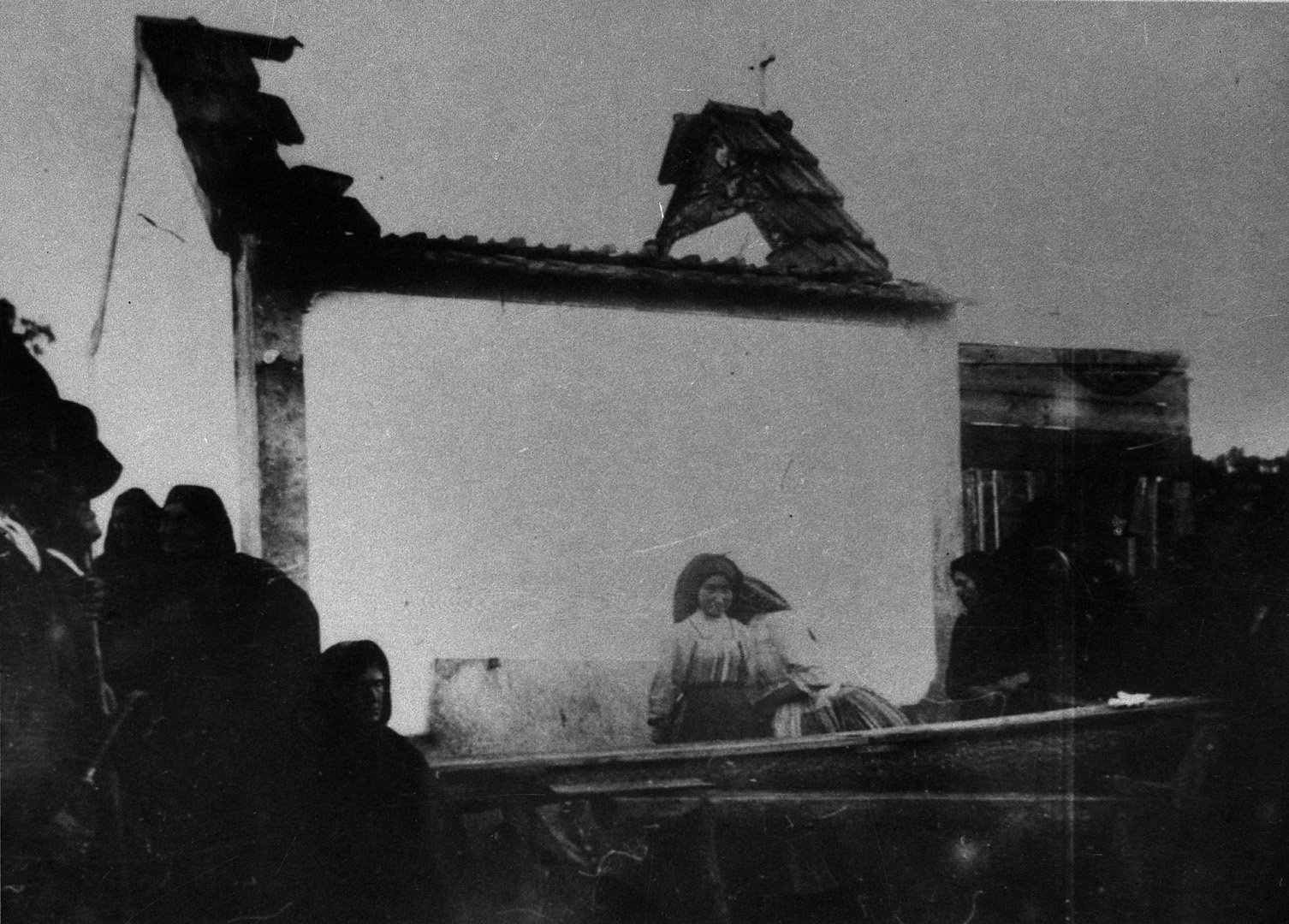
This reading does not make the event less real than the Catholic reading does; in an important sense it makes it more real, because it does not need to treat the participants as passive recipients of a display staged for them. They were its makers. Nor does it make the event a fraud, since no one in the field was pretending; the children were as sincere as McNabb and Blado say they were, and their sincerity is precisely what one would expect from minds that were genuinely channelling, in images they could understand, the energies of the community around them. Sincere vision is not evidence of veridical information about the supernatural order; it is what non-pathological psychic experience looks like from the inside. And the prediction, so central to the C-inductive case, becomes on this reading an expected feature rather than a shocking one. The date was not foreseen so much as set. Once set, it gathered expectation as a lens gathers light, and an event of this kind, if events of this kind occur at all, is exactly the sort of thing that happens where a great deal of collective attention has been focused on a single time and place.
What the mass-event frame refuses is the move from the reality of the event to the authority of the institution that interprets it. If the Lady was the form in which a frightened Catholic people addressed itself, then her messages tell us a great deal about that people, its terrors and its consolations, and nothing in particular about whether the Assumption occurred or whether hell is eternal. The Church that took ownership of Fátima, built the basilica, controlled the publication of the secrets, and folded the event into its apologetic, was doing what institutions do with powerful collective experiences: it was claiming the meaning as its property. That claim is not supported by the event; it is supported by the background, which had already decided that public miracles are signatures and that signatures belong to whoever holds the seal.
Weather: the solar miracle as exteriorized belief climate
If Mass Events supplies the general ontology, the weather sessions of The Nature of Personal Reality, dictated by Roberts in 1973 toward the end of a book begun in the spring of 1972 and published in 1974, supply a vocabulary almost uncomfortably suited to a crowd standing in the rain beneath a sun that would not behave. In Session 666, in Chapter 18, Seth says: “Storms, say, or tornadoes, are brought about by angry men precisely as wars are. They are simply versions of the same phenomena.” In the session before, he describes a thunderstorm as one that “is the exteriorized local materialization of the inner emotional state of the people experiencing the storm.” And in Session 666 again, drawing the anthropological conclusion: “But you can no more separate yourselves from the body of the earth and its condition than you can from your own bodies.”
Read carefully, these lines make a claim that is far stranger than the familiar notion that weather affects mood, and far more relevant to Fátima than anything in the meteorological literature. They say that the causal arrow also runs the other way, that local atmospheric events are, among other things, the outward condition of the inner condition of those who inhabit them, in the way that a blush is the outward condition of an inner embarrassment, and that this is not metaphor but a statement about how human beings and their environment are continuous. A storm, on this account, is not a punishment and not an accident; it is a mood of a place, in which the people of that place participate. If one allows that much, then a field full of people who have spent months in charged expectation, who have walked through a morning of cold, soaking rain toward a promised sign, whose collective emotional state at noon combines exhaustion, dread, hope, devotion, and a kind of desperate collective attention, is a field whose weather might be expected to do something extraordinary. The clearing of the rain at the appointed hour, the pale silver disc that could be looked at without pain, the colours, the rotation, the plunge toward the earth that sent people to their knees — on this reading these are the exteriorized materialization of a belief climate, the sky of the Cova da Iria taking on, for some minutes, the shape of the inner state of those beneath it.
This is the point at which the frame most needs ethical care, because the language of emotions producing weather can be turned very quickly into a language of blame: if storms are brought about by angry men, then the victims of storms are guilty of their anger, and the victims of floods of whatever mass psychic condition the flood expressed. I want to refuse that turn explicitly, and to name the posture I think the material supports with a phrase that is mine, not Seth’s: responsibility without blame. Responsibility, in the sense that matters here, means participation, the recognition that we are not spectators of the public world but contributors to it, and that the collective states of mind we share are among the forces that shape what happens to us together. Blame means something else: a moral accounting in which participation becomes guilt and suffering becomes deserved. Seth’s weather sessions describe participation; they do not issue invoices. Applied to Fátima, this means that the crowd was responsible for the solar miracle in the sense that it was their event, formed from their longing, and not in any sense that would make the event a reward for their virtue or the anticlericals’ absence a sin. Applied more broadly, it means that recognizing the role of collective belief in public events is an invitation to examine the beliefs, not an indictment of the people who hold them.
The weather framing also clarifies why the event was both shared and variable, public and yet not uniform. A storm is a common condition, but no two people inside it experience exactly the same storm; where one sees lightning another hears only rain, and the emotional state of each shapes what each perceives and suffers. If the solar event was the exteriorized materialization of a belief climate, then those most fully inside that climate — the devout, the expectant, the people who had walked for days — would be expected to experience it most vividly, and those at its margins, the sceptics, the curious, the people who had come for the spectacle or the journalism, would be expected to experience it partially, differently, or not at all. That is in fact the pattern the testimony shows, and it is a pattern the signature model handles awkwardly, since a sign intended so that all would believe ought not to be visible only to some. The weather model handles it natively. Weather is local, and belief is a kind of locality.
Soft spots, and the latch of guilt
A frame that wants to be taken seriously by philosophers of religion has to be honest about the evidence even where honesty costs it something, and there are several places in the Fátima record where the popular account is thinner than it sounds. The first is variance. McNabb and Blado themselves note that some witnesses disputed whether the sun moved and some saw nothing at all, and they rightly treat this as a weakness for any account on which God staged a public sign for the purpose of producing belief. I have suggested that the mass-event frame accommodates variance more easily, but I do not want to pretend that variance is therefore evidence for it; the same variance is also what a sceptic would predict on purely perceptual grounds, and the honest conclusion is that the distribution of reports is consistent with several hypotheses and decisive for none.
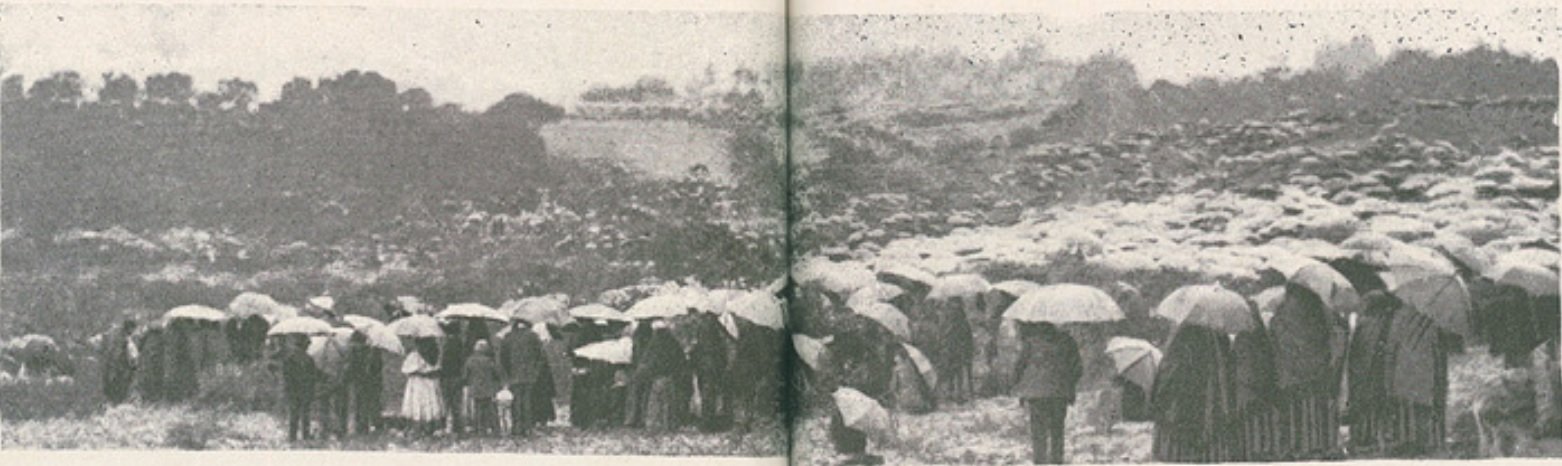
The second soft spot is the drying, which plays a large role in the case against retinal explanations and an even larger role in popular retellings, where clothes soaked through by hours of rain are said to have been dry within minutes. The earliest press accounts do not carry much of this weight. Avelino de Almeida’s report in O Século on 15 October 1917, written by a sceptical journalist for an anticlerical paper and widely cited as hostile-witness testimony, describes heavy morning rain that soaked those without umbrellas, a sun like a dull silver plate that could be looked at without discomfort, and a sun that “danced”; in the text I have been able to review, it says nothing about drying. A pale sun that does not burn the eyes is, if anything, evidence against a sudden flood of radiant heat. The letter of José Maria Proença de Almeida Garrett, dated 3 December 1917, is often quoted as reporting dried clothes, and I have not yet been able to verify that wording against the full text of the critical edition, so I leave it as unconfirmed. The drying becomes thick and vivid in later collections, in De Marchi’s interviews of the 1940s and John Haffert’s Meet the Witnesses of 1961, decades after the event and after the apparitions had become the centre of a national devotion. Benjamin Radford, in a 2019 Skeptical Inquirer piece, argues that photographs taken around the time of the event show few signs of a soaked crowd, that many people had umbrellas, that no one measured anything, and that the drying story looks like folklore that grew in the telling along lines already familiar from Lourdes; his reading of the photographs is impressionistic and he does not engage the named witnesses in detail. Didier Dalleur, in a 2021 paper in Scientia et Fides, argues the opposite, that the photographs and testimony support rapid drying by a warm, oddly moonlike source, and rejects retinal, parhelic, and atmospheric-lens explanations, including Jaki’s. Dalleur’s paper is a serious interpretive case for the miracle, not a neutral measurement. On the physics, sun dogs and halos are always dimmer than the sun and do not focus light onto the ground, so optical explanations of drying are weak; but the drying itself is weakly attested in the earliest sources. The responsible position is that we do not know how wet the crowd was at noon, or how dry it was at half past, and that any argument which leans hard on the drying, whether for God or for a collective field, is leaning on the softest part of the record.
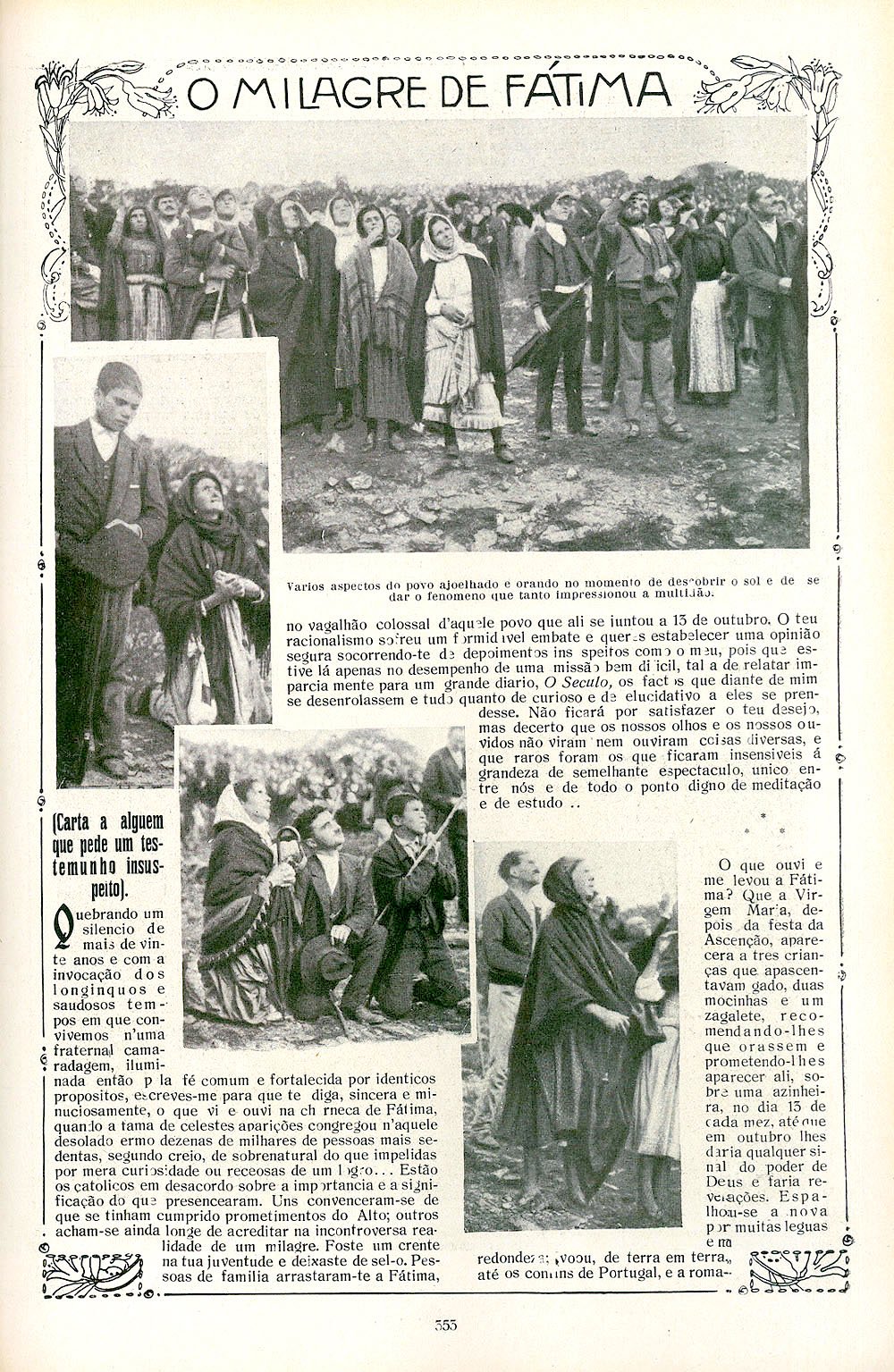
None of this licenses cheap debunking. The core of the event — a large crowd, a predicted date, a clearing sky, a sun that many people, including hostile witnesses, reported behaving in ways suns do not behave — is well enough attested to deserve explanation rather than dismissal, and the textbook materialist who waves it away as afterimages and credulity has not done the work either. My claim is only that the evidential surface is uneven, and that the parts of it which most strongly suggest an external signatory are the parts that grew most in the telling.
There is a further soft spot, and it is not in the evidence but in us. Why does miracle-closure feel, to so many people, not merely like a reasonable inference but like a duty, so that the person who keeps the question open after Fátima seems not just mistaken but recalcitrant? Part of the answer, I think, lies in the moral psychology that the Fátima messages themselves preach, a psychology of sin, guilt, reparation, and penance. Seth’s diagnosis of that psychology in The Nature of Personal Reality is blunt. Speaking in Session 619 of the violence and disorder of the contemporary world, he says: “It is running quite wild now — not despite your ideas of guilt and punishment, but largely because of them.” And in Session 636, distinguishing what he calls natural guilt from the artificial guilt that religious and social systems cultivate, he says: “Even if a violation occurred, natural guilt does not involve penance,” and, a little later, “In a simultaneous time, punishment makes no sense.” Elsewhere, in Session 634, he offers an image of what an innocence untouched by that artificial structure might look like: “A cat playfully killing a mouse and eating it is not evil. It suffers no guilt.”
I cite these lines not as authority but as a hypothesis about why the confirmation argument has the emotional grip it does. A mind organized around guilt experiences underdetermination as exposure, a condition in which one might be found wanting, and it experiences a miracle that confirms an institution with the power to absolve as rescue. The latch is not only epistemic; it is penitential. Fátima’s own content reinforces the latch from inside, since its message is precisely a call to reparation, so that accepting the event’s authority and accepting the duty of penance become a single act. If guilt and punishment are, as Seth suggests, among the causes of the disorder they claim to remedy, then an evidential practice built on them will tend to reproduce them, closing questions not because the evidence closes them but because closure is what the guilty conscience demands.
That latch has a twin. The same psychology that wants the miracle finished, sealed, and owned also tends to want heaven finished: a final arrival, a static beatitude in which development ceases and the soul rests in an unchanging bliss. The Seth material is persistently sceptical of that picture, treating consciousness as unfinished by nature and describing any such static paradise, in my paraphrase, as less a reward than a kind of stagnation that living consciousness would not want. One need not accept that cosmology to notice the structural parallel. A finished miracle ends the question of what happened; a finished heaven ends the question of what we are becoming. Both answer the anxiety of open-endedness by declaring the story over, and both locate the declaration in an authority outside the self. The alternative is not despair but an ongoing participation, in which neither the meaning of Fátima nor the destiny of persons is closed by fiat.
Close
I have not argued that nothing happened at Fátima. I think something did, something that sits very badly with the picture of mind and world that most educated people in the West still carry around, on which consciousness is a late and local glow inside skulls, the sky is indifferent to the field, and seventy thousand people cannot together do anything to the weather except get wet. If the core testimony is roughly reliable, that picture is in serious trouble, and philosophers who are already sceptical of it on other grounds — panpsychists, idealists, theists of a non-interventionist cast, students of parapsychology who take the data seriously without taking the theories on faith — have every reason to treat Fátima as one more piece of evidence that textbook materialism has misdescribed the relation between minds and the world they inhabit. That much I think the event can bear.
What it cannot bear, without a great deal of further argument that has not been given, is the role it is asked to play in the Catholic confirmation argument: extra Bayesian support for a dogmatic package whose philosophical assumptions are never brought into the light. The C-inductive argument, in its careful academic form, is correct about what it actually shows, which is that if one already accepts a Nicene, Marian, interventionist background in which consciousness is causally idle, apparitions are independent informants, and miracles are unilateral signatures, then Fátima favours Rome over Constantinople and Geneva. That is a coherent result within a family argument among Christians. It becomes something else entirely when it is offered to the wider philosophical world as evidence for the package itself, because the work of excluding every rival that does not share those assumptions has been done in advance by the assumptions themselves. A likelihood ratio that never admits the mass-event hypothesis into its denominator cannot tell us that the evidence disfavours it, and a background that has already decided what kind of mind may author a public event cannot then cite the event as proof of that decision.
For readers in the lane where Philip Goff, Timothy O’Connor, and Majesty of Reason do their work, I want to put the alternative as plainly as I can. There are not two options here, a miracle signed by God and a mistake made by a crowd. There is at least a third, on which the event was real, public, and anomalous, and its authorship was distributed among the people who expected it, formed in the symbols they shared, and shaped by the fears and hopes of a nation in crisis. That hypothesis has its own burdens, and I have tried not to hide them. But it predicts the prediction, the Catholic content, and the variance of the testimony at least as well as the Catholic Hypothesis does; it does not require the moral invoice of the package to ride in on the sun; and it has the considerable advantage of taking the crowd seriously as agents rather than as an audience. Goff was right to see that the package is the problem; the further step is to see that hallucination-as-error is not the only way to refuse the package, and that a world in which minds help make public events is one in which Fátima can be fully real without belonging to anyone.
I am not asking Joe Schmid, or anyone else who has found a home in the Church, to leave it; that is not a request an essay has any business making, and people find their way into traditions for reasons richer than any single argument. I am asking something more modest of the discipline. When philosophers of religion weigh Fátima, they should stop treating e as though it floated free of k. They should write down what is in the background — the philosophy of mind, the theory of miracles, the reading of apparitions, the ethics of guilt and penance, the institutional claim to own the meaning — and argue for it as philosophy rather than letting it sit in the dark while the evidence is applauded. If the package survives that examination, it will have earned its lift. If it does not, the sun will still have danced. It will simply have danced for the people who were there, in a language they made together, and not as a seal on a decree that the rest of us are obliged to sign.